

Pretend Play, Real Benefits: How Play Wires the Brain in Childhood
Leo Mahlke
Illustrations by Leo Mahlke
Ready, Set, Play!
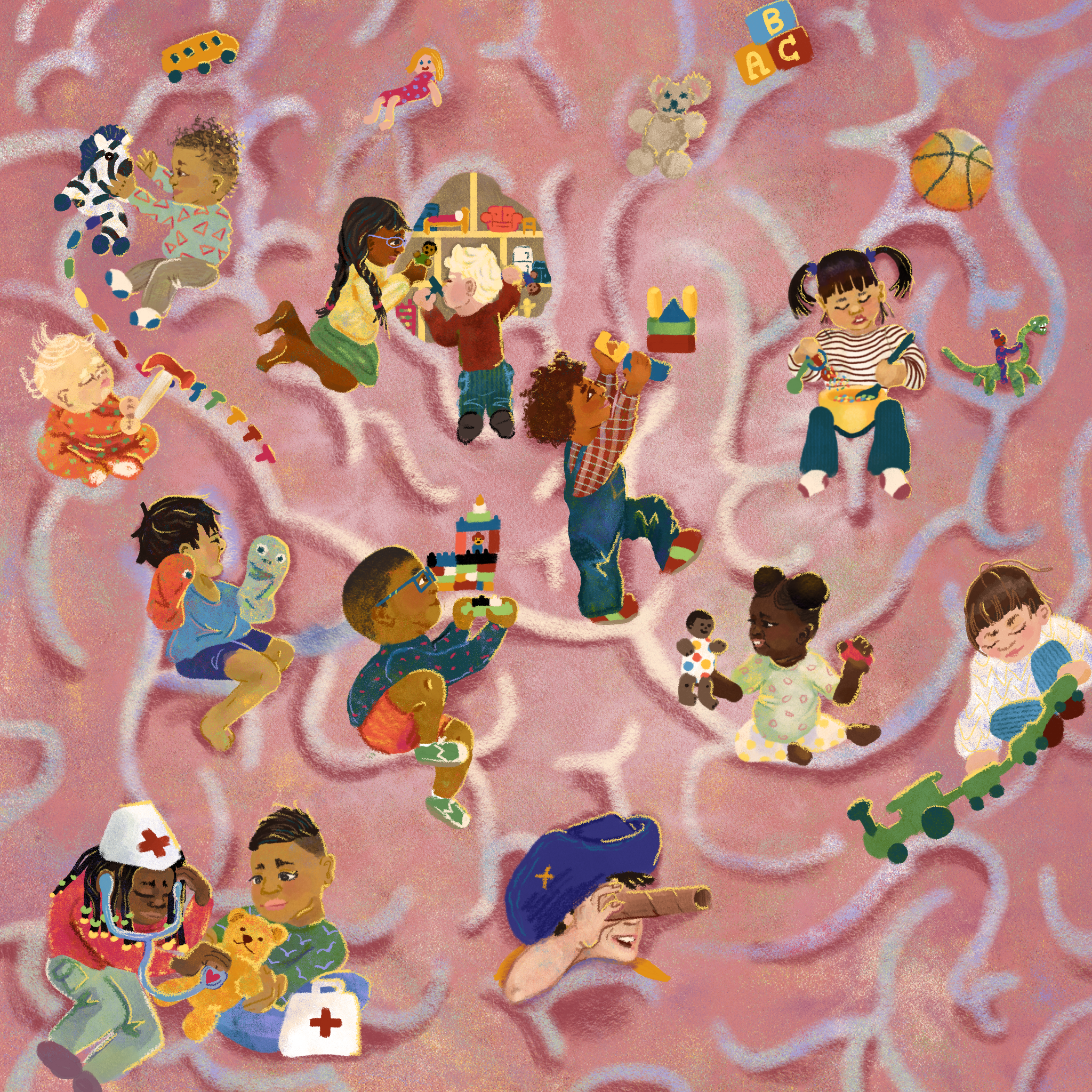
Why is it that babies love playing peek-a-boo with their parents, or building block structures and pretending to cook meals? Play is an integral part of childhood that is not only fun for children, but also important in building foundational skills across development [1, 2, 3]. A baby begins to mimic actions, socially interact, and develop physical abilities through a variety of seemingly simple activities, including peek-a-boo, crawling, or shaking a toy rattle [3, 4]. Once they have a foundation, children can learn to plan and make goal-directed decisions while playing with building blocks [5, 6, 7]. In their toy kitchen, children think creatively and representatively to regard a piece of wood as a hot stove, and a piece of red plastic as an apple [3, 8]. As they play pretend with their friends, they take on a new role, such as pretending to be a mother, and this facilitates the development of social understanding and empathy skills [9]. Throughout childhood, play is a critical, integrative driver of social, cognitive, and sensorimotor development, shaping brain function and even acting as a powerful therapeutic tool for enhancing communication skills [1, 2, 3].
Building Blocks: The Molecular Level of Play
As a child begins to scribble with crayons on a blank sheet, unsure of what the final image will become, they choose certain lines to retrace. Gradually, their scribbles form into a sketch resembling a kitten. As they continue adding more scribbles, they draw a new connection and think their drawing actually looks more like a dragon. The child adds a castle and repurposes fainter sketch marks to create fire bursting from the dragon’s mouth. A similar, though longer, process is occurring at the same time in the child’s brain [10, 11, 12]. The brain undergoes structural and functional changes in response to the environment, a process referred to as neuroplasticity [10]. Neuroplasticity is strongest in childhood as many neurological connections between brain cells form, strengthen, and shift depending on frequency of use [10, 11, 12]. With repetitive use, these connections are reinforced and reassembled into stronger, more efficient circuits, while those that are seldom activated are reorganized to support other relevant cognitive functions [10, 11, 12]. Therefore, during the window of childhood, play functions as an essential contributor to the development of a unified brain — physically connecting regions associated with emotion, cognition, language, and physical movement [1, 3].
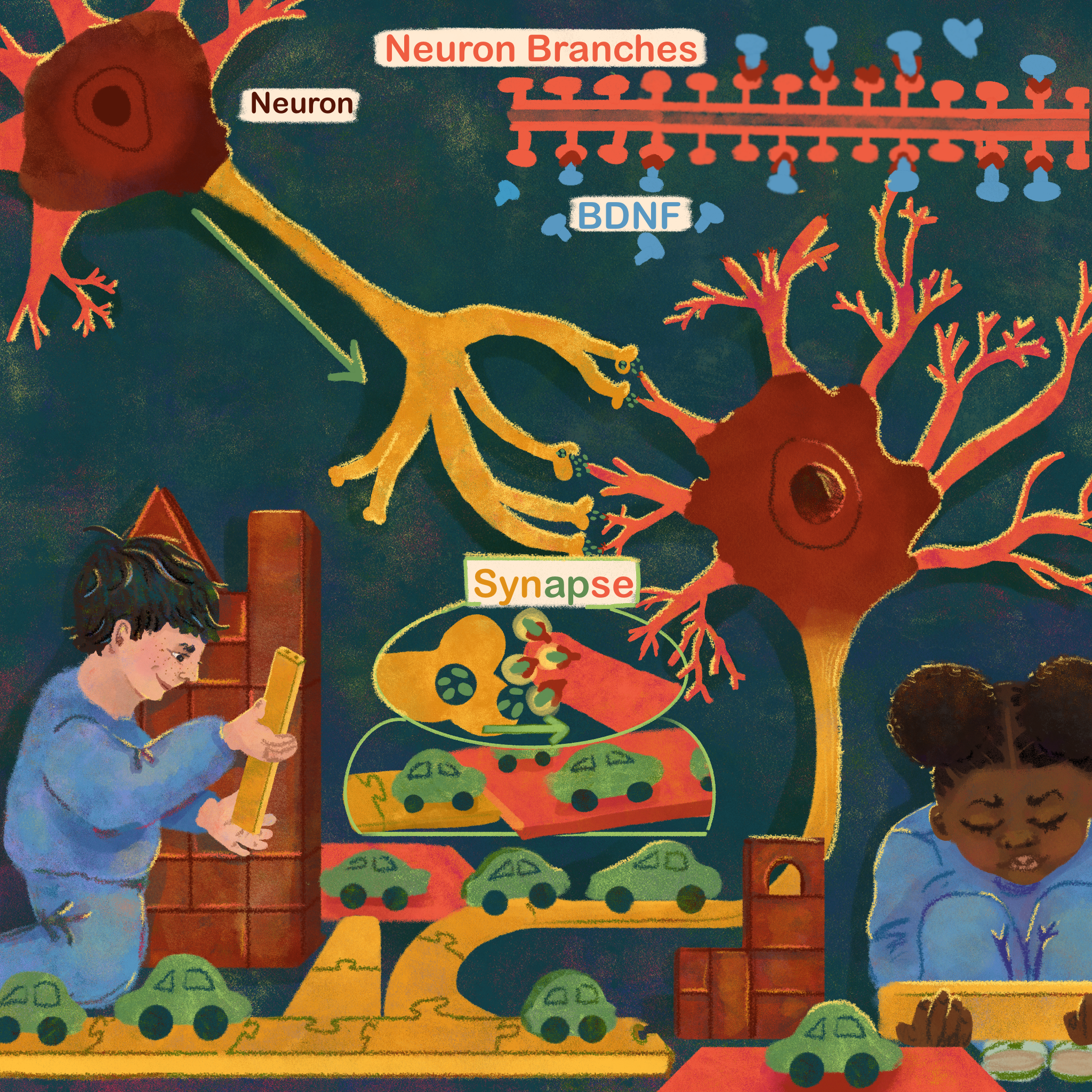
As a child plays, a protein called brain-derived neurotrophic factor (BDNF) increases in abundance [3, 13, 14]. BDNF is a vital protein that supports the brain by aiding in the survival, growth, communication, and specialization of the brain cells called neurons, which respond to stimuli [5]. During play, BDNF production increases in brain regions that process memory, decision-making, self-regulation, attention, fear and aggression, visual integration, and motor skills [5, 6, 15]. Picture two children constructing a block city with long, car-filled roads connecting the buildings. Arranging the blocks engages motor and judgment skills, which stimulate BDNF production in the prefrontal cortex (PFC), a brain region responsible for decision-making, planning, logic, and memory [5, 16]. The increase of BDNF enhances communication between neurons in the PFC such that signals are easier to pass between neurons [5, 17]. Just as the block city has roads that carry toy cars from one building to another, neurons send chemical signals to one another [18]. The toy cars parked outside each building resemble when the chemical signals arrive at the receiving end of an adjacent neuron, and bind to its receptors [18, 19]. When BDNF production is amplified in the PFC, neurons grow more branches that strengthen and stabilize the connections between brain cells, increasing receptor density and enhancing signaling efficiency [5, 17, 18]. These molecular changes support learning, flexibility, and memory, allowing children to build more complex block cities [16, 20].
Think back to a baby playing peek-a-boo with a parent. The baby is smiling, giggling, and wanting the play to continue because they are incentivized by their own enjoyment [4, 21]. They feel rewarded by play because of the release of dopamine, a chemical messenger that reinforces behavior by regulating processes such as incentivization [4, 21]. Similarly, dopamine reinforces social play and supports learning, neuroplasticity, and stress mitigation [3, 4, 5]. Play continues to be rewarding even as children get older due to the development of the hippocampus, a brain region that consolidates learning by turning new experiences into long-term memories [22, 23]. As a result, dopamine flow in this region allows playful activities to capture a child’s curiosity and attention, promoting incentivized, self-motivated learning, and memory consolidation [22, 23]. While dopamine and neuroplastic changes highlight how play shapes the brain at a cellular level, these effects do not occur in isolation [22, 23]. Instead, they influence how entire brain regions interact, revealing how play engages the brain as an integrated system [22, 23].
Building a Dollhouse: The Whole-Brain Level of Neuroplasticity and Play
The seemingly simple play that children engage in often involves a variety of different skills and senses, requiring the brain to use multiple regions simultaneously [1, 2, 5]. As these regions are repeatedly co-activated over time, the connections between them gradually strengthen [1, 2, 5]. Consider a child reaching into a dollhouse, picking up a doll, and role-playing as the character by exclaiming, ‘I’m hungry!’ [1]. The child moves the doll through the house in search of something to eat, accidentally knocking over a toy chair in the process [1, 24, 25]. After picking up the chair, the child also resolves the character’s hunger by placing the doll in the chair at the kitchen table with some plastic food [5, 24]. Within this small and seemingly insignificant moment, the child has simultaneously used language, emotion, creativity, problem-solving, and focused attention [1, 2, 5].
One vital brain network impacted by play is the cortico-cerebellar system [24]. The system comprises the interaction between the premotor cortex, which aids in motor planning, and the cerebellum, a region that executes coordinated motor responses [24, 26]. The cortico-cerebellar system also supports the prediction of actions and the ability to make spontaneous adjustments [24]. The moment the child realized they had knocked over the chair, the cortico-cerebellar system detected a mismatch between the predicted actions and those actually executed [24]. After the child fixes the chair and decides to place the doll in it, they may also predict that a limp doll in a chair may fall out of the seat; therefore, they will make sure it is propped up [24]. As the cortico-cerebellar system becomes more efficient through repeated use, actions become faster and smoother [5, 24]. By playing, the child can also practice calmly devising and executing solutions, demonstrating how role-playing scenarios may help children learn to apply these emotional-regulation skills in real life [1, 5, 27]. This is because pretend play promotes connectivity between the PFC and the amygdala, a brain region associated with fight-or-flight tendencies [5]. Over time, an interactive relationship forms, allowing the PFC to regulate the amygdala’s emotional extremes by filtering them through logical reasoning [5].
Make-Believe Meals: A Recipe for Sensory Integration and Cognitive Skills
As babies grow, their increasing mobility leads them to more perceptual exploration and learning opportunities, strengthening the interdependence between physical, sensory, and cognitive skills [1, 2, 3]. Imagine an infant crawling to a bin of plastic food and dumping it out to search for a toy apple. When playing pretend kitchen, the baby sees the shapes and colors of their toys and hears the crashing sound they make as they tumble from the overturned bin. The baby may even feel the strong contrast between the rough, bumpy texture of the carpet they are crawling on and the smooth surface of their plastic apple, which they might even attempt to bite. Here, the infant is engaging in sensorimotor play, a style of play in which babies actively explore the perceptual properties of objects in their environment [2]. Sensorimotor play is typically initiated through imitation, engaging mirror neurons [1, 2, 28]. Whether we are watching an action or executing it ourselves, mirror neurons respond the same way [1, 2, 28]. Imagine a mom playing with toy kitchenware alongside her baby. She shows them how she stirs her empty bowl with a spoon, and the infant observes before attempting to mirror this motion with their own bowl and spoon. The baby became engaged in play by observing their mom stir a toy bowl, and the activation of their mirror neurons supported them in mimicking her motion [1].
As the infant crawls and dumps out a large bin of food, they use gross motor skills involving whole-limb movement, which support later milestones such as running and jumping [3, 8]. However, when the infant uses their hand to grasp the spoon and drop the plastic apple into their bowl, they use their fine motor skills — precise movements executed by smaller muscles which can be improved with play [3, 8]. Repeated muscular engagement promotes neuromotor development, thus supporting children’s emerging independence and exploratory behavior [2]. Even something as simple as an infant sitting on the floor and reaching for a toy to play with may help refine their range of motion and spatial awareness [2].

In addition to motor development, pretend play encourages children to think both creatively and logically [29, 30]. In this sense, children must flexibly engage in different pathways of thinking and idea-generating, such as divergent and convergent thinking [29, 30]. Divergent thinking is characterized by flexible, open-ended brainstorming, while convergent thinking leads the mind to a single, concrete, and logical solution to a problem [29, 30]. When a four-year-old child cooks a make-believe meal of spaghetti, they recruit their executive control network (ECN), which manages decision-making, problem-solving, and memory [2,31]. Therefore, the ECN allows the child to remember and execute the steps of cooking the meal in a methodical manner [5, 32, 33]. However, the child notices that there is no meatball toy [3, 33]. Now, they must think flexibly to make a logical plan that replaces meatballs with another object [3, 33]. The child must employ divergent thinking, prompting them to creatively devise an alternative path [29, 30]. They scan their environment, see round pom-poms, and decide that the pom-poms will represent meatballs. However, when the child finally settled on the pom-poms and completed the order, they used convergent thinking skills to make and execute a final decision [29, 30]. Both divergent and convergent thinking are enhanced through childhood play because the child is constantly generating a mix of fantastical, emotional, and imaginative ideas and using logic to contextualize them [29, 34, 35].
Producing free-flowing thoughts to generate ideas engages a large network known as the default mode network (DMN), which is active during imaginative and unprompted thinking, such as daydreaming [34, 35, 36]. The DMN and ECN function in parallel to integrate creative thought with goal-directed evaluation, allowing children to develop ideas and identify solutions [30, 34, 35]. More efficient communication between the DMN and ECN is associated with creative abilities, such as switching between spontaneous idea generation and analysis, thereby allowing for the refinement of ideas [29, 34, 35]. As we grow, even seemingly simple interactions such as playing pretend kitchen can influence the ways in which the brain builds relationships between physical, perceptual, and cognitive processes, leading to the development of increasingly complex skills throughout life [1, 2, 3].

The Game of Life: The Social Emotional Benefits of Play
Engaging in play gives children the chance to not only improve their cognitive skills, but also to develop social skills like perspective-taking and empathy [37]. Imagine a group of children playing pretend family, with each child acting out how each family member is portrayed in their own life. ‘Mom’ argues with ‘Sister’ over bedtime. ‘Dog’ barks to get ‘Brother’s’ attention, and he gives his pet some pretend table scraps. ‘Dad’ announces that the baby doll is crying because it got left alone in its cradle. Here, the children are assigning feelings and motives to their own fictional characters [9]. At the same time, they also understand that the other children’s behavior reflects the character they are pretending to be [9]. Therefore, when they play pretend-family, the children are beginning to exercise their emerging empathy, the cognitive ability to anticipate the thoughts and feelings of others while also understanding that they are all pretending [9, 38].
By practicing empathy during play, children can also rehearse social situations ranging from conflict resolution to caregiving [9]. For example, when the child pretending to be ‘Dad’ anticipates that the baby will cry when left alone, they are taking on the baby’s perspective [9, 39]. The child uses both creative thinking and empathy when they decide to stay with the baby doll and care for it [9, 39]. Pretend play recruits a part of the brain known as the posterior superior temporal sulcus (pSTS), which supports a wide variety of processes in social cognition, such as perspective-taking and empathy [39]. Therefore, even when the child playing ‘Mom’ tries to get the ‘Sister’ to go to bed, and the ‘Dog’ must bark to ask for food, the children work on developing an understanding of the emotions and perspectives of others who are different from themselves [9, 39]. Engaging in these activities helps children better understand others’ internal thoughts and feelings, setting up critical lifelong empathy skills [9, 39].
Where Play Meets Therapy!
Because pretend play can help children develop perspective-taking skills and empathy, it can be a powerful tool to implement into therapies for children with neurodevelopmental disorders such as autism spectrum disorder (ASD) [3, 37]. To varying degrees, people with ASD typically engage in restricted, repetitive behaviors and face challenges with sensory integration, social skills, nonverbal communication, and staying in sync with others during conversation [3]. When two people have a conversation, they have several back-and-forth exchanges, maintain eye contact, use appropriate intonation, and adjust their expressive body language as the conversation shifts from topic to topic [40, 41]. As the pair navigates this conversation, they demonstrate interpersonal synchrony — the ability to maintain shared rhythm, coordination, and attention while speaking [40, 41]. People with ASD are more likely to struggle with interpersonal synchrony and often have irregular pausing and timing, lack of eye contact, and responses that may appear emotionally disengaged [40, 41]. Challenges with interpersonal synchrony are associated with atypical activity in the mirror neural network [42]. Some people with ASD may also show reduced activity in brain regions involved in tracking eye gaze and joint attention, a process in which two people each intentionally look at and pay attention to the same object [43, 44].
The integration of pretend play into therapy — or play therapy — for children with ASD helps activate brain regions that facilitate social interaction [3]. Play therapy is not an attempt to make people with ASD act and communicate in ways considered more ‘typical’ [3]. Instead, this intervention aims to help people with ASD practice skills to convey their wants, needs, and thoughts [3]. Since play therapy supports the development of the PFC, engaging in this activity could help people with ASD navigate changes in conversational rhythm, turn-taking, and understanding of shared goals [40, 41]. Play therapy gives people with ASD a chance to practice different social situations, providing them with tools to apply in real-life conversations [45]. As mentioned earlier, the pSTS is activated during social interactions and processing in children, strengthening the region as it is repeatedly activated, which can also help support communication skills for people with ASD over time [45]. Play also strengthens children’s observation-execution matching systems and shared attention on an object or activity, making it an effective tool for therapy [45, 46]. By engaging in an activity such as playing kitchen alongside a therapist, children with ASD develop skills by mirroring their therapist’s actions [3, 46]. Prominent forms of therapy for people with ASD have frequently been reported as highly physically and mentally abusive, viewing ASD as a pathology in need of curing rather than a neurological difference [47]. Play therapy, on the other hand, is intended to be non-disruptive and enjoyable while also being neurologically beneficial [3].
Preserving Pretend Play
Pretend play can support children throughout development, both in its free and spontaneous forms and when it is structured, such as in therapeutic settings [3]. Though crucial to their developmental milestones, the children’s pretend kitchens, blocks, and dollhouses might be left to collect dust. With the increasing domination of technology, children are interacting more and more with electronic devices rather than real toys [3, 48]. As mobile games progressively replace in-person play, children are becoming deprived of the interactions that are crucial to childhood development (See the article on screen time on page X for more information on this topic!) [39, 48]. Given the benefits that play offers to childhood development, ensuring unstructured play is a part of the childhood education experience, such as recess, gives children the space to interact with their environments in free and unprompted ways [49, 50]. While structured play can be beneficial in a therapeutic environment, unguided play allows children to express themselves freely, be curious, and learn from mistakes [49, 50]. Even though play may be seen as a casual pastime, or even a break from learning, it is actually an essential part of childhood and should be taken seriously when it comes to raising children and building education systems [49, 50, 51]. It is vital that we evaluate the tools used to support children’s learning.
References:
Ezmeci, F. (2023). Brain development as 21st-century skills: What is the play doing to my brain? Journal of Pedagogical Sociology and Psychology, 5(3), 21-27. doi.org/10.33902/jpsp.202323257.
Canepa, M. E., & Ramenghi, L. A. (2026). The neurobiology of play: a narrative review of evidence from mice and humans for advancing neurorehabilitation. Frontiers in Neuroscience, 19. doi.org/10.3389/fnins.2025.1729411.
Elbeltagi, R., Al-Beltagi, M., Saeed, N. K., & Alhawamdeh, R. (2023). Play therapy in children with autism: Its role, implications, and limitations. World Journal of Clinical Pediatrics, 12(1), 1–22. doi.org/10.5409/wjcp.v12.i1.1.
Achterberg, E. J., van Kerkhof, L. W., Servadio, M., van Swieten, M. M., Houwing, D. J., Aalderink, M., Driel, N. V., Trezza, V., & Vanderschuren, L. J. (2015). Contrasting roles of dopamine and noradrenaline in the motivational properties of social play behavior in rats. Neuropsychopharmacology, 41, 858–868. doi.org/10.1038/npp.2015.212.
Yogman, M., Garner, A., Hutchinson, J., Hirsh-Pasek, K., & Golinkoff, R. M. (2018). The power of play: A pediatric role in enhancing development in young children. Pediatrics, 142(3). doi.org/10.1542/peds.2018-2058.
Chu, W. T., Mitchell, T., Foote, K. D., Coombes, S. A., & Vaillancourt, D. E. (2021). Functional imaging of the brainstem during visually-guided motor control reveals visuomotor regions in the Pons and midbrain. NeuroImage, 226. doi.org/10.1016/j.neuroimage.2020.117627.
Eisenreich, B. R., Akaishi, R., & Hayden, B. Y. (2017). Control without controllers: Toward a distributed neuroscience of executive control. Journal of Cognitive Neuroscience, 29(10), 1684–1698. doi.org/10.1162/jocn_a_01139.
Matheis, M., & Estabillo, J. A. (2018). Assessment of fine and gross motor skills in children. In Handbook of Childhood Psychopathology and Developmental Disabilities Assessment (pp. 467–484). Springer, Cham. doi.org/10.1007/978-3-319-93542-3_25.
Semeijn, M. (2018). Interacting with fictions: The role of pretend play in theory of mind acquisition. Review of Philosophy and Psychology, 10, 113–132. doi.org/10.1007/s13164-018-0387-2.
Innocenti, G. M. (2022). Defining neuroplasticity. Handbook of Clinical Neurology, 184, 3–18. doi.org/10.1016/B978-0-12-819410-2.00001-1.
Vieira, M. S., Santos, A. K., Vasconcellos, R., Goulart, V. A. M., Parreira, R. C., Kihara, A. H., Ulrich, H., & Resende, R. R. (2018). Neural stem cell differentiation into mature neurons: Mechanisms of regulation and biotechnological applications. Biotechnology Advances, 36(7), 1946–1970. doi.org/10.1016/j.biotechadv.2018.08.002.
Chuma, S., Kiyosue, K., Akiyama, T., Kinoshita, M., Shimazaki, Y., Uchiyama, S., Sotoma, S., Okabe, K., & Harada, Y. (2024). Implication of thermal signaling in neuronal differentiation revealed by manipulation and measurement of intracellular temperature. Nature Communications, 15. doi.org/10.1038/s41467-024-47542-8.
Passos, A. P. D. (2023). Integration of motor, cognitive, nutritional, metabolic, and epigenetic influence variables related to early childhood as a tool to promote child development at kindergarten schools. In Recent Perspectives on Preschool Education and Care. IntechOpen. doi.org/10.5772/intechopen.113145.
Sgro, M., & Mychasiuk, R. (2020). Playful genes: What do we know about the epigenetics of play behaviour? International Journal of Play, 9(1), 25–38. doi.org/10.1080/21594937.2020.1720139.
Miranda, M., Morici, J. F., Zanoni, M. B., & Bekinschtein, P. (2019). Brain-derived neurotrophic factor: A key molecule for memory in the healthy and the pathological brain. Frontiers in Cellular Neuroscience, 13. doi.org/10.3389/fncel.2019.00363.
Bein, O., & Niv, Y. (2025). Schemas, reinforcement learning and the medial prefrontal cortex. Nature Reviews Neuroscience, 26(3), 141–157. doi.org/10.1038/s41583-024-00893-z.
von Bohlen und Halbach, O., & von Bohlen und Halbach, V. (2018). BDNF effects on dendritic spine morphology and hippocampal function. Cell and Tissue Research, 373, 729–741. doi.org/10.1007/s00441-017-2782-x.
Prigge, C. L., & Kay, J. N. (2018). Dendrite morphogenesis from birth to adulthood. Current Opinion in Neurobiology, 53, 139–145. doi.org/10.1016/j.conb.2018.07.007.
Gipson, C. D., & Olive, M. F. (2016). Structural and functional plasticity of dendritic spines – root or result of behavior? Genes, Brain and Behavior, 16(1), 101–117. doi.org/10.1111/gbb.12324.
Amodeo, D. A., Grospe, G., Zang, H., Dwivedi, Y., & Ragozzino, M. E. (2017). Cognitive flexibility impairment and reduced frontal cortex BDNF expression in the Ouabain model of Mania. Neuroscience, 345, 229–242. doi.org/10.1016/j.neuroscience.2016.05.058.
Manduca, A., Servadio, M., Damsteegt, R., Campolongo, P., Vanderschuren, L. J., & Trezza, V. (2016). Dopaminergic neurotransmission in the nucleus accumbens modulates social play behavior in rats. Neuropsychopharmacology, 41, 2215–2223. doi.org/10.1038/npp.2016.22.
Biderman, N., Bakkour, A., & Shohamy, D. (2020). What are memories for? The hippocampus bridges past experience with future decisions. Trends in Cognitive Sciences, 24(7), 542–556. doi.org/10.1016/j.tics.2020.04.004.
Gruber, M. J., & Ranganath, C. (2019). How curiosity enhances hippocampus-dependent memory: The prediction, appraisal, curiosity, and exploration (PACE) framework. Trends in Cognitive Sciences, 23(12), 1014–1025. doi.org/10.1016/j.tics.2019.10.003.
Kerney, M., Smaers, J. B., Schoenemann, P. T., & Dunn, J. C. (2017). The coevolution of play and the cortico-cerebellar system in primates. Primates, 58, 485–491. doi.org/10.1007/s10329-017-0615-x.
Camarata, S., Miller, L. J., & Wallace, M. T. (2020). Evaluating sensory integration/sensory processing treatment: Issues and analysis. Frontiers in Integrative Neuroscience, 14. doi.org/10.3389/fnint.2020.556660.
Fernández, V., Llinares‐Benadero, C., & Borrell, V. (2016). Cerebral cortex expansion and folding: What have we learned? The EMBO Journal, 35(10), 1021–1044. doi.org/10.15252/embj.201593701.
Bredikyte, M., & Brandisauskiene, A. (2023). Pretend play as the space for development of self-regulation: Cultural-historical perspective. Frontiers in Psychology, 14. doi.org/10.3389/fpsyg.2023.1186512.
Henschke, J. U., & Pakan, J. M. P. (2023). Engaging distributed cortical and cerebellar networks through motor execution, observation, and imagery. Frontiers in systems neuroscience, 17, 1165307. doi: 10.3389/fnsys.2023.1165307
Eon Duval, P., Frick, A., & Denervaud, S. (2022). Divergent and convergent thinking across the schoolyears: A dynamic perspective on creativity development. The Journal of Creative Behavior, 57(2), 186–198. doi: 10.1002/jocb.569
Rawlings, B., S., Chetwynd-Talbot, D., Husband, E., Nuttall, A., Quinn, E., Taggart, R., & Roome, H. E. (2025). Divergent thinking is linked with convergent thinking; implications for models of creativity. Thinking & Reasoning, 31(4), 586–608. doi: 10.1080/13546783.2025.2485059
Shen, K., Welton, T., Lyon, M., McCorkindale, A. N., Sutherland, G. T., Burnham, S., Fripp, J., Martins, R., & Grieve, S. M. (2019). Structural core of the Executive Control Network: A high angular resolution diffusion MRI study. Human Brain Mapping, 41(5), 1226–1236. doi: 10.1002/hbm.24870
Buss, A. T., & Spencer, J. P. (2017). Changes in frontal and posterior cortical activity underlie the early emergence of executive function. Developmental Science, 21(4). doi: 10.1111/desc.12602
Clark, C. A., Chevalier, N., Nelson, J. M., James, T. D., Garza, J. P., Choi, H.-J., & Espy, K. A. (2016). I. Executive Control in early childhood. Monographs of the Society for Research in Child Development, 81(4), 7–29. doi: 10.1111/mono.12268
Kucyi, A., Esterman, M., Riley, C. S., & Valera, E. M. (2016). Spontaneous default network activity reflects behavioral variability independent of mind-wandering. Proceedings of the National Academy of Sciences, 113(48), 13899–13904. doi: 10.1073/pnas.1611743113
Zhang, W., Sjoerds, Z., & Hommel, B. (2020). Metacontrol of human creativity: The neurocognitive mechanisms of convergent and divergent thinking. NeuroImage, 210, 116572. doi: 10.1016/j.neuroimage.2020.116572
Sun, J., He, L., Chen, Q., Yang, W., Wei, D., & Qiu, J. (2021). The bright side and dark side of daydreaming predict creativity together through brain functional connectivity. Human Brain Mapping, 43(3), 902–914. doi: 10.1002/hbm.25693
Arda Tuncdemir, T. B. (2025). Integrating social-emotional learning through play: Perspectives from early childhood educators. Journal of Research in Childhood Education, 1–19. doi: 10.1080/02568543.2025.2567504
Shvo, M., Klassen, T. Q., & McIlraith, S. A. (2020). Towards the role of theory of mind in explanation. Lecture Notes in Computer Science, 75–93. doi: 10.1007/978-3-030-51924-7_5
Hashmi, S., Vanderwert, R. E., Price, H. A., & Gerson, S. A. (2020). Exploring the benefits of doll play through neuroscience. Frontiers in Human Neuroscience, 14. doi: 10.3389/fnhum.2020.560176
McNaughton, K. A., & Redcay, E. (2020). Interpersonal Synchrony in autism. Current Psychiatry Reports, 22(3). doi: 10.1007/s11920-020-1135-8
Koehne, S., Hatri, A., Cacioppo, J. T., & Dziobek, I. (2016). Perceived interpersonal synchrony increases empathy: Insights from autism spectrum disorder. Cognition, 146, 8–15. doi: 10.1016/j.cognition.2015.09.007
Bhat, A. N., Hoffman, M. D., Trost, S. L., Culotta, M. L., Eilbott, J., Tsuzuki, D., & Pelphrey, K. A. (2017). Cortical activation during action observation, action execution, and interpersonal synchrony in adults: A functional near-infrared spectroscopy (FNIRS) study. Frontiers in Human Neuroscience, 11. doi: 10.3389/fnhum.2017.00431
Bolis, D., & Schilbach, L. (2018a). Observing and participating in social interactions: Action perception and action control across the autistic spectrum. Developmental Cognitive Neuroscience, 29, 168–175. doi: 10.1016/j.dcn.2017.01.009
Zhang, K., Chen, J., Yang, Z. et al. Investigating joint attention in children with autism spectrum disorder through virtual reality and eye-tracking: a comparative study. Educ Inf Technol 30, 18779–18798 (2025). https://doi.org/10.1007/s10639-025-13554-0
Keating, J., Hashmi, S., Vanderwert, R. E., Davies, R. M., Jones, C. R., & Gerson, S. A. (2023). Embracing neurodiversity in doll play: Investigating neural and language correlates of doll play in a neurodiverse sample. European Journal of Neuroscience, 60(3), 4097–4114. doi: 10.1111/ejn.16144
Schottelkorb, A. A., Swan, K. L., & Ogawa, Y. (2020). Intensive child‐centered play therapy for children on the autism spectrum: A pilot study. Journal of Counseling & Development, 98(1), 63–73. doi: 10.1002/jcad.12300
Kirkham, P. (2017). ‘the line between intervention and abuse’ – autism and applied behaviour analysis. History of the Human Sciences, 30(2), 107–126. doi: 10.1177/0952695117702571
Hosokawa, R., & Katsura, T. (2018). Association between Mobile Technology use and child adjustment in early elementary school age. PLOS ONE, 13(7). doi: 10.1371/journal.pone.0199959
Russ, S. W. (2016). Pretend play: Antecedent of adult creativity. New Directions for Child and Adolescent Development, 2016(151), 21–32. doi: 10.1002/cad.20154
Houser, N. E., Roach, L., Stone, M. R., Turner, J., & Kirk, S. F. L. (2016). Let the children play: Scoping review on the implementation and use of loose parts for promoting physical activity participation. AIMS Public Health, 3(4), 781–799. doi: 10.3934/publichealth.2016.4.781
Prompona, S., Papoudi, D., & Papadopoulou, K. (2019). Play during recess: Primary School Children’s perspectives and Agency. Education 3-13, 48(7), 765–778. doi: 10.1080/03004279.2019.1648534